Nvidia's RTX 4060 and RTX 4060 Ti are the cards that really should be getting the Super treatment
Published: January 01, 0001

This week I've been getting on the new APU and GPU train: With AMD and Nvidia both releasing new silicon that's where my 2024 has started, elbow deep in chip benchmarking. My happy place.
The is here! They won't dramatically upend the graphics card landscape, but then again, it's hard to argue with more performance at the same or lower price points, so in that respect, they're welcome improvements.
The may still receive a Ti upgrade at some point, but it's already the fastest card, so I'll skip over that one. That leaves two cards that really could use the Super treatment. I'm pointing the finger at you two over there in the corner, the and the .
The , and were generally well received for their performance improvement and general efficiency, though their pricing still copped them some flak. Less well received were the RTX 4060 and RTX 4060 Ti. They're still supremely power efficient, but their weak specifications and Nvidia's decision to use historically lower tier GPUs in these cards meant they are viewed less favorably than their RTX 30-series predecessors. Nvidia may have undisclosed plans to update them later in 2024, for now, what you see is what you get. And that's a shame.
Before I get to my hopes for Super RTX 4060 H25 สล็อต and RTX 4060 Ti models, I need to revisit the current non-Super versions by posing the question: How do we really classify a graphics card? If we stick to performance and value for money, then the RTX 4060 and RTX 4060 Ti do what they're supposed to do. Both deliver intergenerational performance improvements, and they include support for very useful technologies including DLSS 3 and Frame Generation. Their power efficiency is a standout and their pricing is the same or less than it was for the previous generation. When viewed in those terms, both cards earn approval.
If the RTX 4060 was known as the RTX 4050 and the RTX 4060 Ti was the RTX 4060 then adequate would not be an accurate descriptor. Such cards could have been something special.
But we know what's under the hood of both cards, and that's the source of their criticisms. Perhaps a good way to describe them is 'adequate'. If the RTX 4060 was known as the RTX 4050 and the RTX 4060 Ti was the RTX 4060, and both were priced appropriately, then adequate would not be an accurate descriptor. Such cards could have been something special. Nvidia would have earned rave reviews and social media and forum commentary would have given it a year's worth of PR smiles.
If the RTX 4060 debuted as the RTX 4050, priced at something like $229, I'd be singing its praises from the rooftops. But that's not what happened. It's a budget GPU with xx60 nomenclature. The AD107 GPU at its heart is relatively tiny at 119mm². It comes with 3,072 activated shaders, 8GB of VRAM and 128-bit bus. They're not specifications we'd expect from a 2023 mid-range graphics card. Compare those specs to its RTX 3060 12GB predecessor. It uses the 276mm² GA106 GPU with 3,584 shaders, 12GB of VRAM as the name suggests, and a 192-bit bus. The RTX 4060 is absolutely a regression by comparison.
It's a similar story for the RTX 4060 Ti. Its AD106 GPU measures in at a still small 188mm² and it's got 4,352 shaders. That's an improvement over the RTX 4060, sure, but it's still stuck with 8GB of VRAM, and 128-bit bus. I'll ignore the $100 premium for the 16GB version as that's just too much of an ask. Compare that to the 392mm² GA104 GPU of the RTX 3060 Ti, with 4,864 shaders and a 256-bit bus, and again we're looking at a regression.

My thinking is that both the AD107 and AD106 GPUs (and the AD104 and AD103 for that matter) ended up performing better than Nvidia expected them to. That gave Nvidia the choice of elevating each GPU up by one tier. Both chips did just enough for Nvidia to save face when it accurately stated they outperformed their predecessors.
The use of lower spec GPUs allows Nvidia to save money thanks to the much larger number of usable dies per wafer, while fast GDDR6 speeds and larger L2 cache levels meant it could get away with less complex PCB designs. Chuck in a marketing blitzkrieg on the benefits of DLSS 3 and Frame Generation and we have the RTX 4060 and RTX 4060 Ti.
But both cards could be sooooo much better, and they're the cards I want to see get the Super treatment ahead of any others in the RTX 40-series range.
Here's what I'd like to see. A future RTX 4060 Super could basically take the place of the RTX 4060 Ti. Equip it with the AD106 GPU, with let's say 3,840 shaders and 16GB of GDDR6 (or even GDDR6X) and you'd have a much stronger card. Nvidia could even up the price and I wouldn’t complain.
An RTX 4060 with the AD106 GPU and RTX 4060 Ti with the AD104 GPU are definitely possible. But will Nvidia go down that path?
It could do the same with an RTX 4060 Ti Super. Using the AD104 (as the RTX 4070 uses) would be a big step forward. Though the 5,888 shader count of the RTX 4070 is already far below the maximum capabilities of the fully enabled 7,680 shader count of the AD104, a variant with even fewer shaders, plus GDDR6 (not necessarily GDDR6X) with a 192-bit bus would put it much closer to the RTX 4070 than it is to the RTX 4060 Ti non-Super.
There's a new precedent too. The RTX 4070 Ti Super is set to include the faster AD103 GPU, the same as that found in the RTX 4080, albeit with fewer shaders activated. An RTX 4060 with the AD106 GPU and RTX 4060 Ti with the AD104 GPU are definitely possible. But will Nvidia go down that path?
Competition has a lot to do with it too. The AMD Radeon and are solid competitors, but their MCM design, extra VRAM and complexity will probably prohibit them from dropping down to price points that give Nvidia the shudders. The is only a match for the 4060, so there's not much pressure there. Intel's Battlemage generation may yet throw up some . I look forward to seeing what those cards can do.
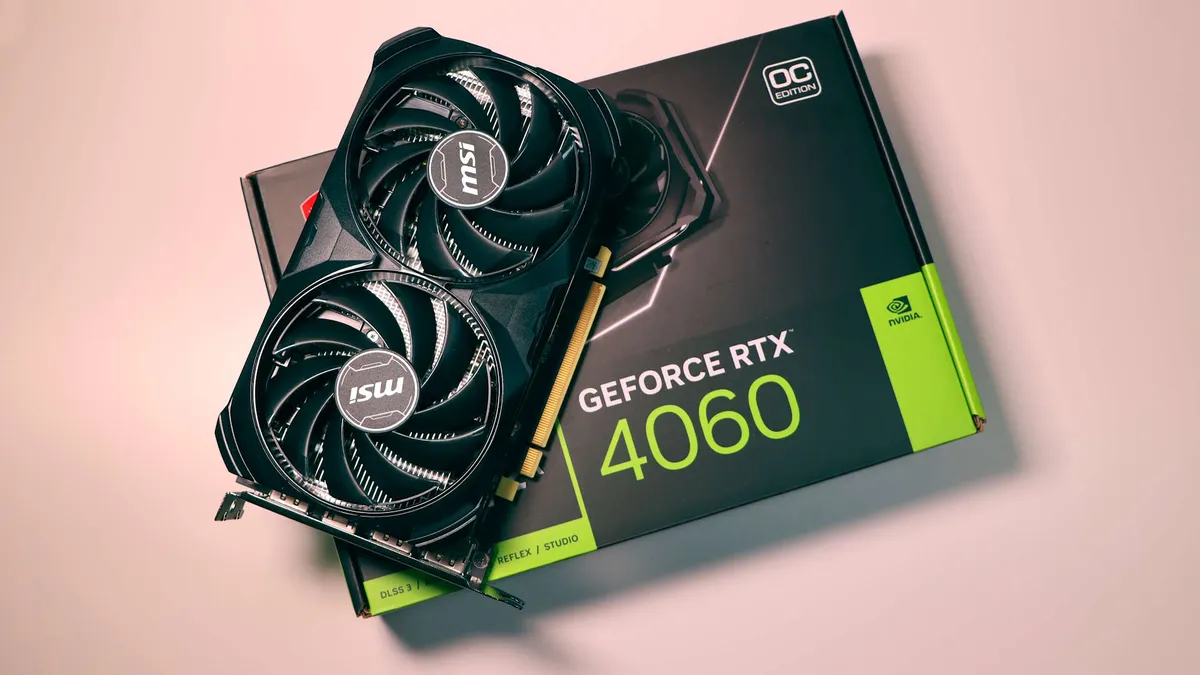
2023 was a pretty crappy year for a lot of people. Cost of living pressures and inflation hurt the pockets of gamers, meaning discretionary purchases of graphics cards had to be put off.
Throwing money at a merely adequate upgrade isn't enough. Make it a worthy one. By giving the RTX 4060 and RTX 4060 Ti the Super treatment, gamers would be much more incentivized to retire ever popular cards like the GTX 1060 and RTX 2060.
Come on Nvidia, throw us a bone. You're making a killing on AI, but your roots are in gaming. We're not expecting charity, but giving mainstream gamers a Super incentive to upgrade wouldn’t hurt the bottom line too much. Would it?
Recommended Reading
Image 1 of 3(Image credit: Future)(Image credit: Future)(Image credit: Future)Fun aesthetic additions to the insides of cases [[link]] aren't exactly a new concept but one thermaltake design from CES this year...
Microsoft will soon, depending on when this latest round of layoffs are actioned, [[link]] have let go over 2,500 total staff since purchasing Activision Blizzard for $69 billion.An internal memo shared by IGN...
Outrage on a Reddit forum is hardly a novel concept. Outrage at AI is likewise not exactly [[link]] a major newsflash. But in a new twist, the latest unrest is a direct result of Redditors being subject to an ...
Comments (3)
The progressive jackpots are thrilling, and it's exciting to watch the jackpot amounts grow as more players spin the reels. I hope they add even more jackpot slots because it adds a lot of excitement to the gameplay. The payout process is generally smooth and reliable, though occasionally it takes longer than expected. Overall, I feel confident that my winnings are safe and will be credited properly. The mobile interface is smooth and intuitive. I can play all my favorite slots on the go without experiencing any lag or glitches. The design is responsive and user-friendly, which makes gaming on my phone just as enjoyable as on my computer.
I love the overall aesthetic of the platform. The animations, visual effects, and sound design make the gaming experience more dynamic and immersive. It's one of the reasons I keep coming back. I appreciate the themed slot games, especially those based on movies and TV shows. They make the gaming experience more engaging and immersive. The combination of storyline, visuals, and bonus features makes each game feel unique. The payout process is generally smooth and reliable, though occasionally it takes longer than expected. Overall, I feel confident that my winnings are safe and will be credited properly.
I appreciate the themed slot games, especially those based on movies and TV shows. They make the gaming experience more engaging and immersive. The combination of storyline, visuals, and bonus features makes each game feel unique. The progressive jackpots are thrilling, and it's exciting to watch the jackpot amounts grow as more players spin the reels. I hope they add even more jackpot slots because it adds a lot of excitement to the gameplay. Customer support has been outstanding whenever I had any issues. They respond quickly and professionally, ensuring that any concerns with deposits, withdrawals, or gameplay are addressed immediately, which makes me trust the platform more.